Documents Required for Renting an Apartment in Zurich (2026 Checklist)
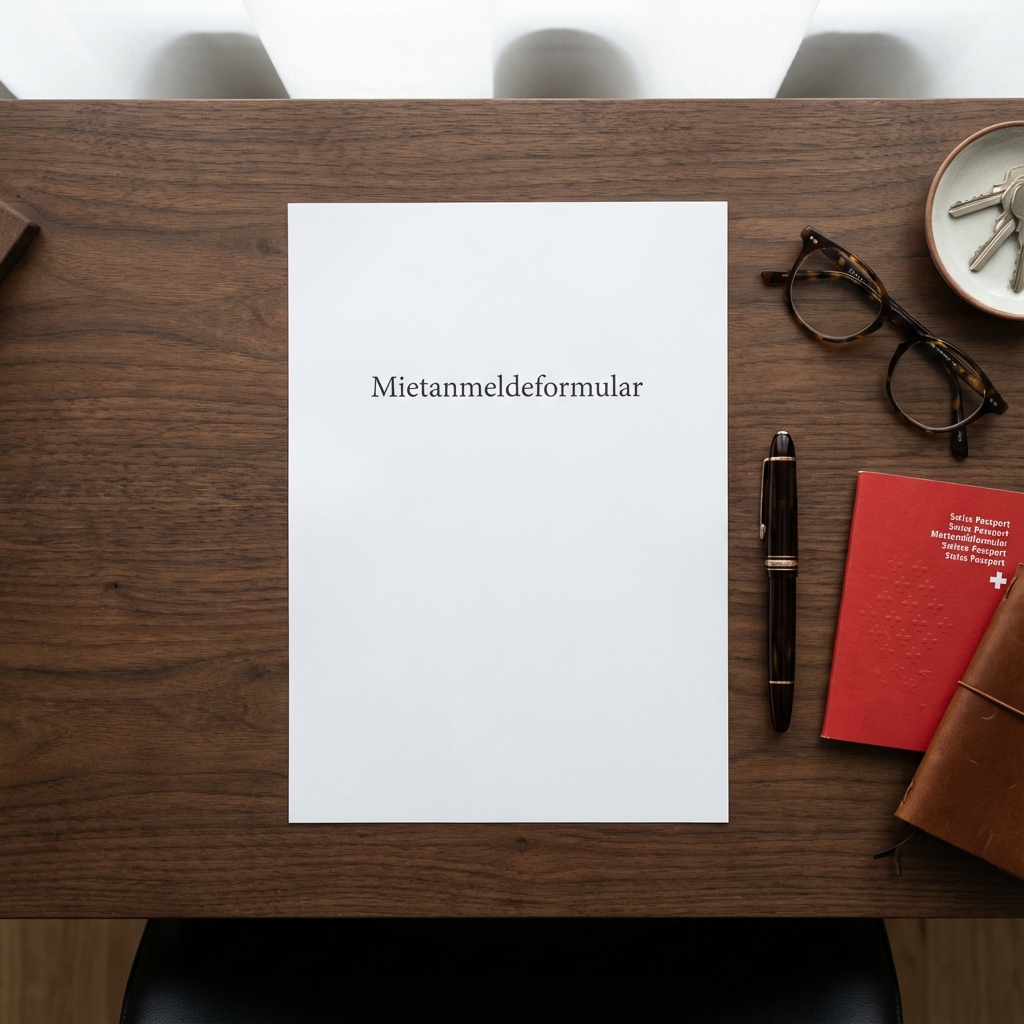
To rent an apartment in Zurich you need a copy of your passport or ID, your Swiss residence permit (or the permit assurance), a debt collection register extract no older than three months, proof of income such as an employment contract or recent payslips, and the agency's completed application form. A short cover letter, a landlord reference and proof of liability insurance make your file stronger. If you have just arrived, a home-country credit report replaces the Swiss debt extract.
The Zurich Rental Application Checklist
| # | Document | Required? | If you have just arrived |
|---|---|---|---|
| 1 | Passport or national ID (colour scan) | Always | Same |
| 2 | Swiss residence permit (B, C, L) | Almost always | Permit assurance letter from the canton, or employer confirmation |
| 3 | Debt collection register extract (Betreibungsregisterauszug), max. 3 months old | Almost always | Home-country credit report plus a one-line explanation |
| 4 | Proof of income: signed employment contract or last 3 payslips | Always | Signed Swiss employment contract |
| 5 | Agency application form (Anmeldeformular), completed and signed | Always | Same |
| 6 | Cover letter, one page, ideally with a photo | Strongly recommended | Same, mention your relocation date |
| 7 | Reference from your current landlord | Often requested | Reference from your landlord abroad, in English |
| 8 | Private liability insurance (Privathaftpflicht) | Before signing | Take out a Swiss policy on arrival |
| 9 | For self-employed or HNWI applicants: tax returns or a bank reference letter | Case by case | Bank confirmation of assets |
Merge everything into one PDF in this order. The sections below explain each item and how to handle the gaps expats typically have.
TL;DR / Executive Summary
- The Trinity of Documents: A Swiss rental dossier strictly requires: 1) Identification/Permit, 2) Proof of Solvency (Income/Contract), and 3) An official Debt Collection Register Extract (Betreibungsregisterauszug).
- The Catch-22 for Expats: You often cannot get a Swiss debt extract without a Swiss address, but you cannot get a Swiss address without the extract. You must substitute this with a credit report from your home country (e.g., Schufa, Experian) and a letter of explanation.
- The 1/3 Income Rule: Most Swiss landlords expect your monthly rent to stay at or below about one-third of your gross monthly income.
- The Format: Submit everything merged into a single, perfectly formatted PDF file. Do not send multiple loose JPEG images.
- The Off-Market Bypass: The public market is saturated, often with 50+ applicants per viewing. Accessing the private "whisper market" via platforms like Offlist allows you to apply directly to landlords, bypassing public competition and the rigid automated filtering of corporate agencies.
You found the perfect apartment in Zurich's Seefeld district. It has lake views, high ceilings, and modern appliances. You eagerly click "Contact Agency" on Flatfox or Homegate, draft a polite message, and hit send.
By the time you hit send, 100 other people have already applied.
In Switzerland's major economic hubs—Zurich, Geneva, Zug, and Basel—the rental market is not a meritocracy of politeness; it is an administrative gauntlet. Landlords and massive property management agencies (Verwaltungen) are overwhelmed by demand. When they receive a mountain of applications for a single luxury apartment, they do not read them all. They filter them.
The primary filter is not who would be the most pleasant neighbor. The primary filter is Completeness and Solvency. If your application dossier (Bewerbungsdossier) is missing a single page, if your scans are blurry, or if a required document is older than three months, your application is usually set aside without a reply. For the relocating executive or high-net-worth individual moving to Switzerland, this system is uniquely perilous because you often lack standard Swiss paperwork.
Here is how to build a complete dossier that gets you to the top of the pile, and how to avoid part of this public competition entirely. If Swiss rental vocabulary is new to you, keep our Swiss rental glossary open alongside.
Stop Searching.
Be Found.
Join the private network used by Switzerland's top executives. Start your onboarding with just your email.
1. The Debt Extract (The Expat Catch-22)
The Betreibungsregisterauszug (Extract from the Debt Collection Register in German, or Extrait du registre des poursuites in French) is the single most important document in Switzerland. It is the gold standard for proving you have no unpaid debts, no bankruptcies, and no outstanding legal claims against you.
Every landlord demands an original, recent copy. It cannot be older than three months from the date of your application.
The Problem: The extract is issued by the debt collection office of the municipality where you are registered. If you have just arrived in Switzerland, or are applying from abroad before your arrival, there is no Swiss record to report yet, and you cannot order an extract for an address you do not live at.
The Solution: You must proactively address this gap before the agency's algorithm rejects you.
- Order an Extract as Soon as You Are Registered: Once you are registered in a Swiss municipality, order the extract from the local Betreibungsamt (Debt Collection Office), in person or online. It will simply show no entries. Even if it proves little for a newcomer, having the document ticks the box on the checklist.
- The Foreign Substitute: If you are applying from abroad, attach an official, recent credit score report from your home country (e.g., Schufa for Germany, Experian or Equifax for the UK and US).
- The Crucial Disclaimer: Never just attach the foreign document. You must include a specific sentence in your cover letter explicitly stating: "As I am relocating from [Country] and do not yet have a Swiss registered address, a local Betreibungsauszug is unavailable. Please find attached my official credit report from my home country to verify my financial standing."
2. Income Verification and the 1/3 Rule
Swiss landlords do not guess your ability to pay; they calculate it rigidly. The golden rule of Swiss real estate is the 1/3 Rule: Your total monthly rent (including incidental costs like heating and parking) must not exceed 33% of your gross monthly income. Some very conservative agencies even push this to 25%.
How do you prove this?
- The Standard: If you are already working in Switzerland, provide the last three monthly payslips.
- For New Arrivals & Executives: Provide your fully signed Employment Contract. Ensure that the exact gross annual salary, start date, and the signature of your employer are clearly visible. If your compensation includes a large variable bonus, ask your HR department to write a supplementary letter confirming your expected total target compensation.
- For Entrepreneurs & HNWI: This is significantly harder. A Swiss agency cannot easily verify a foreign LLC or varying dividend payouts. You will need your last two definitive tax returns. Even better, provide a formal letter stamped and signed by a reputable Swiss accountant or a recognized bank (a "Bank Reference Letter") confirming that your liquid assets are more than sufficient to cover multiple years of rent.
3. Identification and Permit Status
Every application requires a clear, high-quality color scan of your Passport or National ID card. Do not take a dark, blurry photo with your smartphone. Use a scanner app.
The Expat Gap: The application will ask for your Swiss Residence Permit (B-Permit, C-Permit, or L-Permit). If you are moving for a new job, your permit is likely still processing. If public agencies do not see a physical permit card, their automated software (such as Flatfox) might reject you immediately.
How to bypass this: You must attach an "Assurance of Residence Permit" (Zusicherung der Aufenthaltsbewilligung). Our guide to renting in Switzerland without a residence permit explains the full sequence. This is an official document from the cantonal migration office confirming that your permit has been approved and will be issued upon your arrival. Alternatively, a formal letter from your employer's immigration lawyer confirming that the work permit application has been filed and is legally expected to be approved is often accepted by human administrators.
4. The Cover Letter (Your Secret Weapon)
In a sea of identical PDFs and digital application forms, personality wins. Include a one-page cover letter (written in the local language of the canton—German for Zurich/Zug, French for Geneva) with a professional photograph.
A standard Swiss cover letter should not be an essay, but it should cover specific points:
- Who are you? Keep it professional. "I am a Senior Manager at Google, relocating to Zurich for a minimum 3-year assignment."
- Who is moving in? Precision is key. "My wife (an Architect) and our 6-year-old daughter." Do not simply write "Family."
- Musical Instruments and Pets: Honesty is mandatory. If you play the drums, you will be rejected from most apartments. If you play the piano, specify that it is an electric piano with headphones. If you have a dog, state the breed, age, and attach a photo of the dog along with proof of liability insurance. A "secret" pet is immediate grounds for eviction in Switzerland.
- The "Soft" Sell: Landlords want peace, quiet, and reliable payments. Mention that you are looking for a stable, long-term home and value a quiet environment.
5. Merging: Digital vs. Paper
Ten years ago, you brought a physical, neatly bound folder to the apartment viewing and handed it to the owner. Today, almost all large agencies use digital portals.
The Golden Rule of Submission: If sending via email to a private landlord or a bespoke agency, merge every single document into ONE single PDF file.
Never send 10 separate JPEG attachments. A property manager reviewing 50 applications does not have the time to download and organize your loose files.
Name the file professionally: Application_StreetName_Apartment_YOURNAME.pdf. Make it as easy as possible for them to click, read, and forward to the owner.
The Pivot: Why Play a Rigged Game?
If the process above sounds exhausting, it is because it is intentionally designed to be a barrier. The public housing market in Switzerland is fundamentally saturated.
Traditionally, access to the hidden, private housing market (the "whisper market") was reserved for executives whose employers hired full-service relocation agencies (our relocation agent cost analysis shows what that costs). These agencies skipped the Flatfox queues, made direct phone calls to private landlords, and placed their clients without ever showing a public Betreibungsauszug.
The Problem for everyone else: "Normal" expats, self-driven professionals, and even high-net-worth individuals attempting to search on their own are locked out of this VIP network. You are forced to compete with 50+ people for public listings, meticulously formatting your PDF dossier and hoping a junior administrator doesn't accidentally delete your email.
The Offlist Solution
Offlist is democratizing this access. We are opening up the relocation agency's decades-old, tightly guarded network of private landlords, family offices, and off-market inventory directly to the self-driven professional.
You no longer need a corporate relocation package to access the VIP list. By joining Offlist, you bypass the public agencies. You apply directly to private landlords who value international talent and understand the expat timeline. You skip the massive public viewings and the software algorithms designed to reject you.
What if you didn't need to stress over the formatting of a dossier because you were the only applicant the landlord was talking to? Create your free private profile once, with your documents attached, and let landlords come to you.
The "Off-Market" Expat Advantage
Private landlords in the Offlist network understand the reality of global mobility. They are not bound by the rigid, computerized rules of corporate property management firms.
When you apply for an off-market property through our private network, landlords understand the "Expat Gap":
- They accept "Assurance of Permit" letters instead of demanding physical cards.
- They accept Foreign assets, international employment contracts, and global credit scores as proof of solvency.
- They engage in English, removing the friction of translating your cover letter into flawless formal German or French.
Your dossier is still your first impression. Being perfectly organized signals that you will treat the apartment with the same level of immaculate care. But presenting that perfect dossier to an audience of one—rather than an audience of fifty—is the difference between settling for whatever you can find, and living exactly where you want to be.
Frequently Asked Questions (FAQ)
Can I use a copy of the Debt Extract?
For the initial digital application, a high-quality color scan is acceptable. However, before signing the legally binding lease agreement, the vast majority of landlords will request to see the original physical paper document with the official cantonal stamp. Never throw the original away.
Can I apply for Zurich apartments before I move?
Yes. Many relocating professionals sign their lease from abroad after a video viewing or a short scouting trip. Our guide to renting a Swiss apartment from abroad covers viewings, deposits and signing remotely.
I don't have my B-Permit yet. Will I be automatically rejected?
On public portals like Homegate, you might be filtered out by software if you cannot upload the permit. In off-market scenarios or with private landlords, you will not be rejected. Simply attach a letter from your HR department or the cantonal migration office confirming that your permit has been approved and is currently in processing.
Do I need liability insurance to apply?
You do not necessarily need it to apply, but you absolutely must have it to sign the lease. Private Liability Insurance (Privathaftpflichtversicherung) covering accidental damage to rental property is mandatory in almost all Swiss lease agreements. We highly recommend purchasing it immediately upon arrival to avoid delays when you are offered a contract.