Zurich vs. Geneva: Salaries, Rent, Tax & Lifestyle Compared (2026)
Key Takeaways
- Salaries: Median full-time pay is similar: CHF 7,502 a month in the canton of Zurich and CHF 7,893 in the canton of Geneva (2024).
- The Tax Gap: At CHF 300k taxable income, the tax burden in the city of Geneva is about 5 percentage points higher than in the city of Zurich.
- The Rent Reality: Both markets are extremely tight (vacancy 0.52% in the canton of Zurich and 0.31% in Geneva, June 2026). Geneva's régie system makes the search process structurally different.
- The Language Factor: Zürich operates in Swiss German with strong English penetration in corporate life; Geneva is French-first, and daily life — from landlords to parent committees — runs in French.
- The Career Split: If you work in banking, tech, or insurance, Zürich is the gravitational center. If your world is diplomacy, commodities trading, or international organizations, Geneva is the only address.
Zurich or Geneva? In short: Zurich is larger, German-speaking and has the lower income tax; Geneva is French-speaking, more international and slightly more expensive overall. Median salaries are close, housing is scarce in both, and the right choice usually follows your industry and your language.
Every year, thousands of executives relocating to Switzerland face this choice and receive the same unhelpful answer: "it depends." This guide makes that answer concrete, starting with the numbers.
Zurich vs. Geneva at a Glance
| Zurich | Geneva | |
|---|---|---|
| Population, city (end 2025) | 452,421 | 210,601 |
| Population, canton (end 2025) | 1,628,081 | 537,191 |
| Median gross salary, full-time, canton (2024) | CHF 7,502 / month | CHF 7,893 / month |
| Vacancy rate, canton (1 June 2026) | 0.52% | 0.31% |
| Existing rent, mid-size flat | CHF 1,578 median, 3 rooms, city (2024) | CHF 1,639 average, 4 pièces, canton (2025) |
| Rent for a newly let mid-size flat | not published | CHF 2,006 average, 4 pièces (2025) |
| Prime family apartment, asking rent (indicative) | CHF 4,800–6,500 (4.5 rooms, Seefeld/Enge) | CHF 5,000–7,000 (110–120 m², Champel/Eaux-Vives) |
| Tax burden, single, CHF 150k taxable income | 21.0% | 27.5% |
| Tax burden, married, CHF 300k taxable income | 26.1% | 31.0% |
| Top marginal income tax rate | 39.7% | 45.0% |
| Main language | Swiss German / German | French |
Sources and notes: Population: Statistik Stadt Zürich, Kanton Zürich and Canton of Geneva. Salaries: Swiss Earnings Structure Survey 2024 (FSO) and OCSTAT via Tribune de Genève. Vacancy: FSO, June 2026. Rents: Statistik Stadt Zürich rent survey 2024 (all rented apartments, including cooperatives) and OCSTAT Geneva (free-market apartments). Geneva counts the kitchen as a room, so a Geneva "4 pièces" is roughly a Zurich 3 to 3.5-room apartment. Tax: combined federal, cantonal and municipal income tax in % of taxable income in the cantonal capital, 2024, excluding church tax (Taxbooks, based on Dr. Tax). The prime asking rents are indicative ranges from our own placements, not official statistics.
Two things stand out. First, salaries are not the deciding factor: the median Geneva employee earns slightly more than the median Zurich employee, although sector mix matters more than the city (finance pays top salaries in both). Second, the tax gap is real and grows with income, which is why the net difference usually favours Zurich for high earners.
Both cities are global-tier, both sit on spectacular lakes, both offer safety and infrastructure that most capitals cannot match. But beneath the surface, they are profoundly different places — different languages, different tax regimes, different rental markets, different professional ecosystems, and different cultural expectations for how you integrate.
What follows is not a lifestyle listicle. It is a section-by-section comparison built from years of placing executives in both cities. Figures are sourced where official data exists and marked as indicative where they come from our own experience.
A Tale of Two Cities
Zürich: The Economic Engine
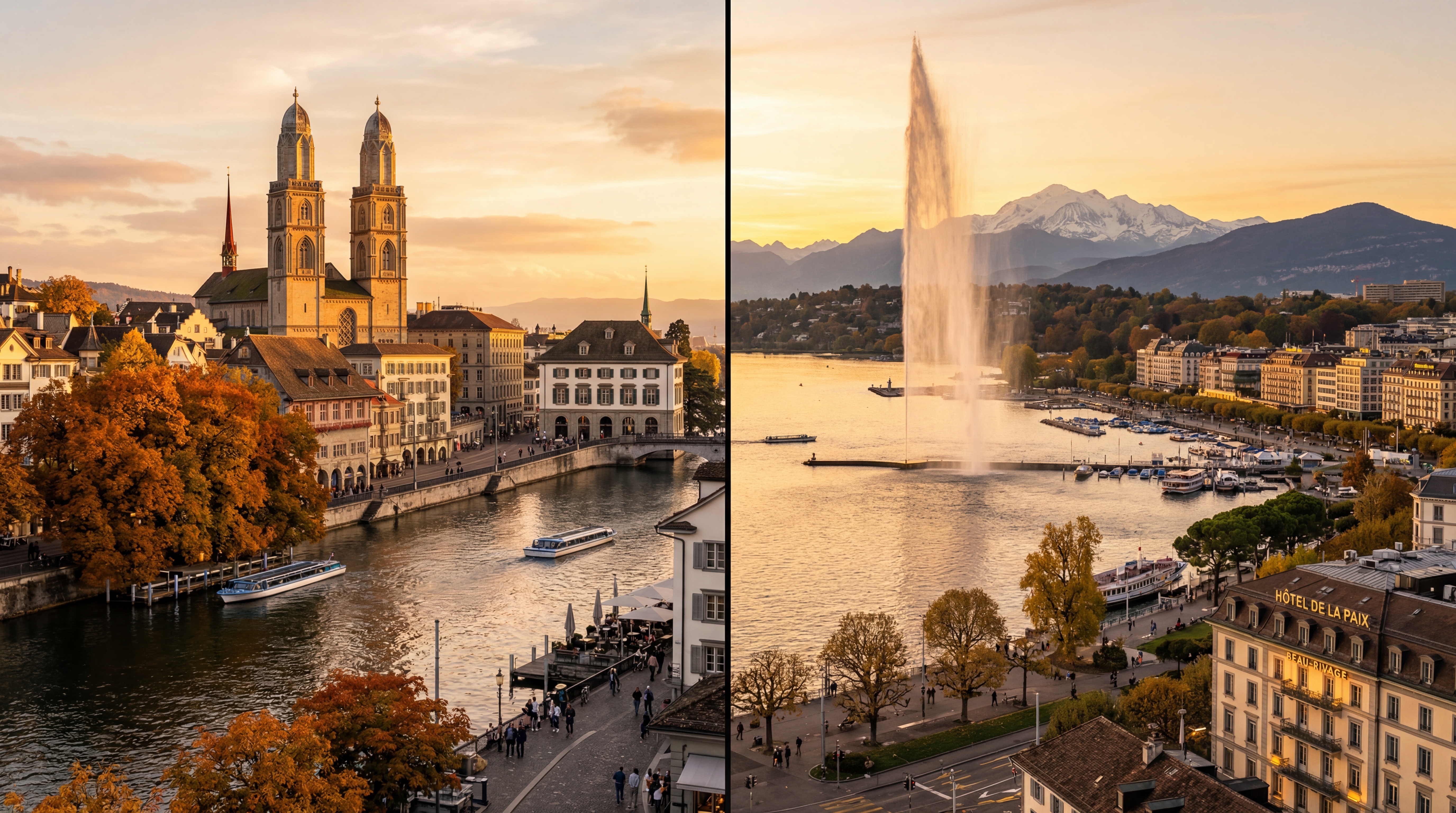
Zürich (452,421 residents at the end of 2025, 1.63 million in the canton) is the largest city in Switzerland and its financial capital. The economy orbits around Paradeplatz, home to UBS (which absorbed Credit Suisse), Zurich Insurance and Swiss Re, but the last decade has added a large tech layer. Google runs one of its largest engineering sites outside the United States in Zurich, and many other global tech firms have offices here. The startup ecosystem around ETH Zürich is arguably the strongest in continental Europe.
The language is Swiss German (Züritüütsch), with High German (Hochdeutsch) used in writing and formal settings. English is widely spoken in corporate environments and increasingly in restaurants and retail, but official correspondence, lease agreements, and government interactions remain in German.
Geneva: The Diplomatic Capital
Geneva (210,601 residents in the city and 537,191 in the canton at the end of 2025) is smaller, francophone, and oriented outward. It hosts the European headquarters of the United Nations, the World Health Organization, the World Trade Organization, the Red Cross, and over 40 international organizations. The private sector is dominated by commodities trading (Trafigura, Mercuria, Gunvor), private banking (Pictet, Lombard Odier, Union Bancaire Privée), and the luxury watch industry.
The language is French — not Parisian French, but a Swiss variant that is slightly more formal and precise. English penetration is lower than in Zürich for daily life. Your régie (property management agency), your commune office, and your children's public school will operate in French. The international bubble around the UN district (Nations) and Cologny can insulate you, but integration demands French fluency.
Cost of Living: A Line-by-Line Comparison
Both cities regularly appear in global top-ten most-expensive-cities rankings, but the cost structures differ in important ways.
Rent
Rent is the largest expense for most expat families, and the comparison is nuanced.
- Official averages: The median net rent of a 3-room apartment in the city of Zurich was CHF 1,578 in 2024, but this includes long-standing leases and cooperative flats. In Geneva, a free-market 4 pièces averaged CHF 1,639 in 2025, while flats let to new tenants in the previous twelve months averaged CHF 2,006. What you pay as a newcomer is always well above the average of existing leases.
- Zürich prime (Seefeld, Enge, Hottingen): In our experience, a modern 4.5-room apartment (around 120 m²) runs roughly CHF 4,800–6,500 a month. Older stock in Kreis 6 or 7 can be found for less.
- Geneva prime (Champel, Eaux-Vives, Florissant): The equivalent apartment (110–120 m²) typically commands CHF 5,000–7,000 a month. Villas in Cologny and Vandœuvres, Geneva's "gold coast", go well above that.
For the Zurich districts expats favour, see our Seefeld and Enge neighbourhood guide; for Geneva, our guide to private landlord rentals in Geneva.
Groceries and Dining
A weekly grocery basket for a family of four (Migros/Coop level) runs CHF 250–300 in both cities — the difference is negligible. Dining out, however, diverges: a mid-range dinner for two in Zürich averages CHF 120–160; in Geneva, CHF 130–180, partly driven by the French dining culture that favors longer, more elaborate meals.
Childcare and Health Insurance
- Crèche (daycare): Zürich offers income-scaled rates at subsidised Kitas; Geneva's crèche system is notoriously oversubscribed. As an indicative range, a dual-income executive family should budget CHF 2,200–3,200 a month per child for a full-time private place in either city.
- Health insurance (KVG/LAMal): Premiums are set by canton. Geneva is consistently among the most expensive cantons for mandatory health insurance, while Zurich sits closer to the national average (Federal Office of Public Health, 2026 premiums).
Tax Comparison: Where the Real Difference Lives
Tax is where the Zürich vs. Geneva decision becomes quantitative. Switzerland's federal tax is identical everywhere; what varies dramatically is the cantonal and municipal layer.
Effective Tax Rates at Key Income Levels
The figures below are the combined federal, cantonal and municipal income tax burden in the two city municipalities for 2024, as a percentage of taxable income, without children and excluding church tax (Taxbooks, based on Dr. Tax).
| Taxable income | Zurich, single | Geneva, single | Zurich, married | Geneva, married |
|---|---|---|---|---|
| CHF 75,000 | 13.0% | 19.3% | 9.8% | 10.7% |
| CHF 150,000 | 21.0% | 27.5% | 16.8% | 21.5% |
| CHF 300,000 | 29.8% | 35.0% | 26.1% | 31.0% |
| Top marginal rate | 39.7% | 45.0% | 39.7% | 45.0% |
At CHF 300,000 of taxable income, a gap of about five percentage points is roughly CHF 15,000 a year. Taxable income is lower than gross salary after social contributions and deductions, so run your own case through the federal tax calculator before you negotiate a package.
Wealth Tax
Both cantons levy wealth tax, but the structure differs. Zürich's wealth tax is moderate. Geneva's wealth tax has higher marginal rates but offers a "bouclier fiscal" (tax shield) that caps the combined income and wealth tax at 60% of net taxable income — a critical protection for UHNW individuals with large portfolios. For executives whose wealth is primarily in securities rather than income, Geneva's shield can be advantageous despite the higher headline rates.
The Zug and Schwyz Factor
It is worth noting: many executives who work in Zürich choose to live in Canton Zug (about 25 minutes by train) or Schwyz (Freienbach/Wollerau) to access much lower tax rates. At CHF 150,000 of taxable income, a single person paid 14.1% in the town of Zug in 2024, against 21.0% in Zurich (same source as above). Our Zug luxury rentals guide covers the housing side. This option has no real equivalent on the Geneva side — the nearby French communes (Annemasse, Ferney-Voltaire) offer lower costs but introduce cross-border taxation complexity that rarely nets out favorably.
Housing Market Dynamics
Vacancy and Competition
Zürich's vacancy rate has hovered around or below 0.5% for years: 0.52% for the canton on 1 June 2026, and about 0.1% in the city itself in 2025. Competition for quality apartments is fierce, and dozens of applicants per listing are common in desirable districts. The standard process involves submitting a Bewerbungsdossier (application file) with proof of income, debt register extract (Betreibungsregisterauszug), references, and often a personal letter.
Geneva is even tighter: at 0.31% on 1 June 2026, it had the second-lowest vacancy rate of any canton after Zug. The market also has its own friction. The régie system — where large property management firms (Naef, Pilet & Renaud, Gérance Romande) control most of the rental stock — creates an intermediary layer that can slow the process. Personal connections to régie managers matter. The dossier culture exists but is less standardized than in German-speaking Switzerland.
Off-Market Access
In both cities, the most desirable properties — penthouses, lake-view apartments, historic villas — rarely appear on Homegate or ImmoScout24. In Zürich, off-market access flows through Verwaltungen (property management companies) with exclusive mandates and private networks. In Geneva, the régie firms hold similar power, but the social dynamics differ: Geneva's smaller, more interconnected francophone elite means that word-of-mouth and personal introductions carry even more weight.
Lease Terms and Tenant Protections
Swiss tenancy law is federal and applies equally in both cities. However, cultural norms differ. In Zürich, landlords tend to be more process-driven and documentation-heavy. In Geneva, relationships and reputation can override a marginal dossier. Both cities offer strong tenant protections — challenging rent increases through the Schlichtungsbehörde (Zürich) or the Commission de conciliation (Geneva) is a well-established right.
International Schools
For families with children, the school question often decides the city.
Zürich
- Zurich International School (ZIS): Campus in Adliswil and Wädenswil (outside the city). IB curriculum. Annual tuition CHF 32,000–42,000 depending on grade level. Waitlists can run 6–12 months for popular entry years.
- Inter-Community School Zürich (ICSZ): Located in Zurich-Wollishofen. IB Primary and Middle Years Programme. Tuition CHF 28,000–38,000. Smaller community, strong pastoral care.
- Swiss International School (SIS): Bilingual German-English programme. An attractive middle path for families who want integration into the Swiss system alongside English instruction.
Geneva
- Ecole Internationale de Genève (Ecolint): The oldest international school in the world (founded 1924). Three campuses: La Grande Boissière (Pregny), La Châtaigneraie (Founex), Campus des Nations (Saconnex). IB and French Baccalauréat options. Tuition CHF 30,000–40,000. Massive alumni network in diplomacy and international organizations.
- Collège du Léman (CdL): Located in Versoix, north of Geneva. Day and boarding. IB, Swiss Maturité, French Bac, American AP options. Tuition CHF 28,000–38,000 (day), CHF 75,000–95,000 (boarding).
- Institut International de Lancy (IIL): French-English bilingual, strong for younger children. Tuition CHF 25,000–33,000.
Tuition figures above are approximate annual ranges; check each school's current fee schedule. For neighbourhoods that work with each Geneva campus, see our Geneva school-run neighbourhood guide.
Geneva's international school ecosystem is deeper and more diverse, reflecting its larger diplomatic community. Waitlists at Ecolint (particularly La Grande Boissière) can exceed 12 months — registering before your move is not optional, it is essential.
Stop Searching.
Be Found.
Join the private network used by Switzerland's top executives. Start your onboarding with just your email.
Lifestyle and Culture
The Lake Effect
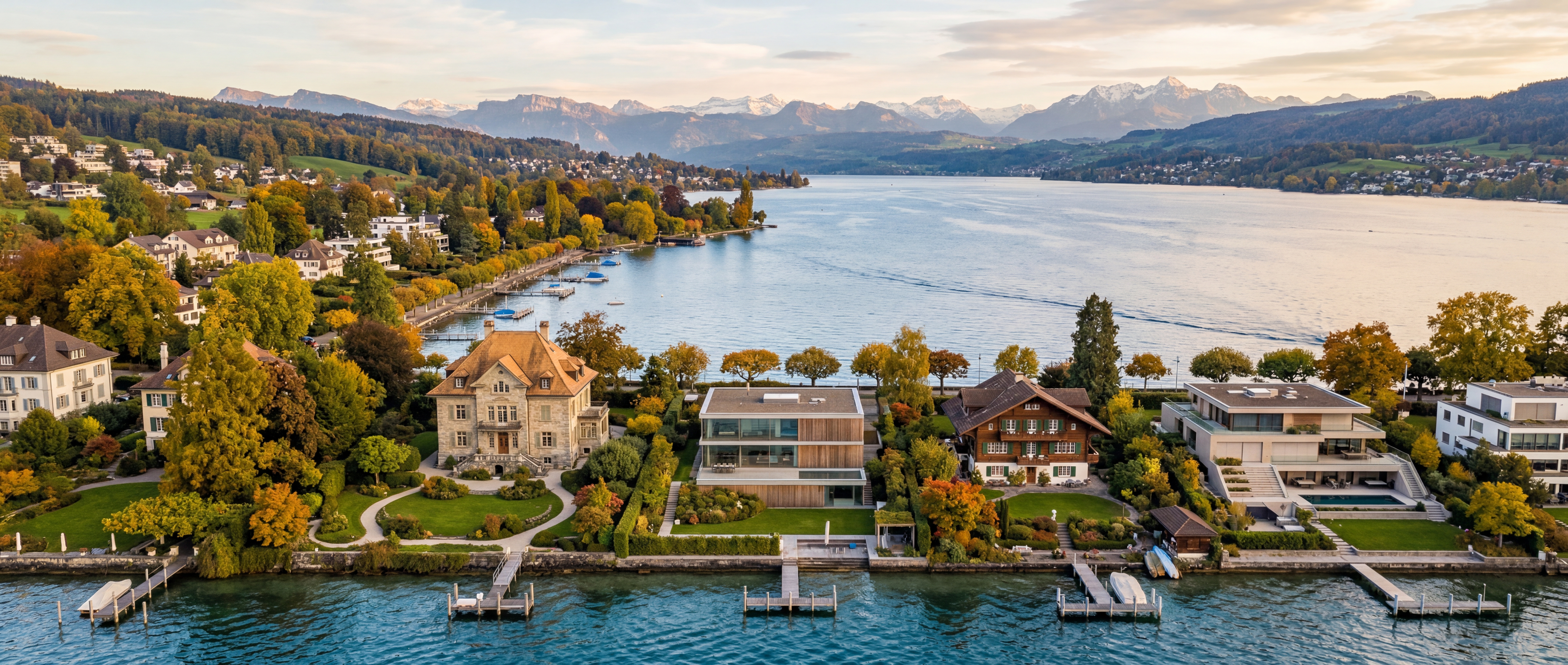
Both cities are defined by their lakes — but the experience differs. Zürichsee is intimate, with Badi culture (public lakeside swimming areas) deeply embedded in summer life. Seebad Enge, Tiefenbrunnen, and Mythenquai fill up on warm evenings with locals swimming after work. Geneva's Lac Léman is grander in scale, with the Jet d'Eau as its icon, but the lakeside experience is more promenade than plunge — the Bains des Pâquis being the notable exception.
Mountains and Skiing
Zürich has the edge on alpine access. Flumserberg, Hoch-Ybrig, and the Engadin are 1–2 hours away. Zermatt, Verbier, and Laax are manageable day trips. Geneva offers Chamonix (45 minutes), Verbier (90 minutes), and the Portes du Soleil — exceptional proximity to world-class French and Swiss skiing. For committed skiers, Geneva's access to Chamonix and the French mega-resorts is arguably unmatched.
Nightlife and Dining
Zürich's nightlife is more developed — Langstrasse and Zürich-West offer a genuine club and bar scene. The Zürich culinary landscape has diversified enormously, with strong Asian, Middle Eastern, and New Nordic options alongside traditional Swiss fare. Geneva's dining scene is more French-inflected and formal. The Carouge district provides the closest thing to a bohemian quarter, but Geneva generally shuts down earlier than Zürich.
Cultural Expectations
The German-Swiss concept of Ordnung (order) pervades Zürich life — recycling schedules are strict, noise rules after 22:00 are enforced, and your neighbors will notice if you do not sweep the communal stairway. In Geneva, the French-Swiss temperament is marginally more relaxed on surface formalities, but the social fabric can be harder to penetrate. Geneva's francophone elite is tight-knit, and building genuine local friendships often requires French fluency and patience.
Career and Networking
Zürich: Paradeplatz and Beyond
Zürich is the headquarters city. If you are in asset management, insurance, reinsurance, fintech, deep tech, medtech, or pharma-adjacent consulting, this is where the density of employers, clients, and talent sits. The networking ecosystem is structured — industry associations (Swiss Finance Institute, digitalswitzerland, Greater Zurich Area), English-language events, and a culture of direct, efficient relationship-building.
The English-friendliness of professional Zürich is high. Board meetings at multinationals run in English. Headhunters operate in English. But the moment you step into a Gewerbe (trade/SME) context or cantonal government, you are back in German.
Geneva: Place des Nations and the Trading Floor
Geneva's career ecosystem is bifurcated. The international-organization track (UN, WHO, WTO, NGOs) operates entirely in English and French and represents a distinct labor market with its own salary scales, immunities, and social dynamics. The private-sector track — commodity trading, private banking, family offices — is smaller but exceptionally lucrative. Geneva commodity traders are among the highest-paid professionals in Switzerland.
Networking in Geneva is more relationship-driven and less event-driven than in Zürich. The Société de Lecture, private clubs, and school-parent networks (especially around Ecolint) function as de facto professional hubs. English is spoken widely in the international bubble but less so in the local business community.
The Verdict: It Depends — But Now You Know on What
There is no objectively superior city. But there is a superior city for you, and the decision rests on a handful of concrete variables.
Choose Zürich if: Your career is in banking, tech, insurance, or pharma. You prioritize lower taxes and a larger German-speaking professional network. You value a more structured, process-driven rental market and are comfortable with (or willing to learn) German. You want the broadest range of corporate employers and the most liquid executive job market in Switzerland.
Choose Geneva if: Your career is in international organizations, commodities, private banking, or luxury goods. You speak (or want to live in) French. You value proximity to France (Chamonix, Annecy, Divonne) and a more international, cosmopolitan social fabric. You have children who would benefit from Geneva's deeper international school ecosystem. You are a UHNW individual who can leverage the bouclier fiscal.
The hybrid path: A growing number of Geneva-based executives live in Canton Vaud (Nyon, Morges, Lausanne), commuting 15–45 minutes by train. Tax is not automatically lower there, though: Lausanne's burden is close to Geneva's at most income levels, so compare your commune before you choose. Our Lausanne relocation guide covers the housing market.
Whichever city you choose, the best apartments in both rarely reach the portals. Create a free private profile so landlords with off-market homes in Zurich and Geneva can find you.
Whatever you choose, do not make the decision based on a weekend visit. Spend time in both cities during a working week. Walk the neighborhoods. Visit the schools. Sit in a Kaffee in Enge and a café in Carouge. The data will narrow your options; the feeling will make the final call.
Frequently Asked Questions
How do salary levels compare between Zurich and Geneva?▼
They are close. In 2024 the median full-time gross salary was CHF 7,502 a month in the canton of Zurich (Federal Statistical Office) and CHF 7,893 in the canton of Geneva (OCSTAT). Your sector matters far more than the city: finance and commodity trading pay well above the median in both.
What gross salary should I target in Zurich or Geneva?▼
Work backwards from rent and tax. Landlords expect the rent to be no more than about a third of gross income, so a CHF 5,000 apartment implies roughly CHF 180,000 a year. For the same gross salary you will keep more in Zurich, because income tax in the city of Geneva is several percentage points higher.
Which city is bigger, Zurich or Geneva?▼
Zurich, by a wide margin. At the end of 2025 the city of Zurich had 452,421 residents and the canton 1.63 million, while the city of Geneva had 210,601 and the canton 537,191.
Can I work in Zürich and live in Geneva (or vice versa)?▼
Technically yes, but it is rare and impractical. The train takes about 2 hours 45 minutes each way. Some executives split the week (Monday–Wednesday in Zürich, Thursday–Friday remote from Geneva), but this requires employer flexibility and careful tax planning — you are generally taxed where you physically work, which can create dual-canton obligations.
Is it true that Geneva is more expensive than Zürich?▼
Overall, yes, mainly because of tax. Income tax in the city of Geneva is several percentage points higher than in Zurich at most income levels, and Geneva's health insurance premiums are among the highest in Switzerland. Rents are broadly similar and extremely tight in both cities, and groceries, dining and transport cost about the same.
Which city is easier to settle into without speaking the local language?▼
Zürich. English penetration in Zürich's professional and service sectors is higher than in Geneva's. You can navigate landlords, doctors, and government offices in English more easily in Zürich — though learning German remains important for long-term integration. In Geneva, daily life outside the international bubble runs in French, and not speaking it creates real friction.
What about Lausanne or Basel as alternatives?▼
Lausanne is an increasingly popular "third way": francophone, with a tax burden close to Geneva's, home to EPFL and a growing tech scene, with lake and mountain access rivaling both cities. Basel appeals to pharma executives (Roche, Novartis) and offers a distinctly cultural, tri-border lifestyle with lower rents than either Zürich or Geneva. Both are worth evaluating if your career permits the geographic flexibility.

About the Author
Benjamin Amos Wagner
Founder of Expat-Savvy.ch & Offlist | Connecting Expats with Homes