Property Valuation in Switzerland: What Is Your Home Really Worth?

Key Takeaways
- The gap: In our experience, many owners overestimate what their home is worth. Purchase price, renovation spend and emotional attachment are not pricing models.
- The science: Swiss banks and valuers rely heavily on hedonic models (such as IAZI and Wüest Partner) that derive value from a property's measurable characteristics and large transaction datasets.
- The trap: Cantonal tax values (Steuerwert, valeur fiscale) are fiscal figures, usually set well below market value. Using them as a price benchmark is a costly mistake.
- The edge: A certified valuation typically costs a few thousand francs and can save far more in a mispriced negotiation, whether you are selling, refinancing or considering an off-market sale.
How do you get a property valuation in Switzerland? You have four options: a free online hedonic estimate (a quick indication), your bank's appraisal (conservative, done for lending), a certified independent valuer (the reference for legal, tax and family matters), or a broker's comparative market analysis (the most market-aware view for a sale). For a sale, the most reliable picture usually comes from combining a hedonic estimate with local transaction knowledge.
The gap between perceived value and market value is one of the most expensive blind spots in Swiss real estate. Owners anchor to their purchase price, their renovation spend, or what the neighbour sold for three years ago. The market works differently: with statistical models, cantonal fiscal values that have little to do with price, and very local demand.
Whether you are thinking of selling your Zurich apartment, refinancing your Geneva villa, or simply want to know whether your asset has appreciated, this guide explains the models, the common mistakes and your professional options.
How to Get a Property Valuation in Switzerland: Step by Step
- Start with an online hedonic estimate. Free tools from providers such as Wüest Partner or RealAdvisor give you a first range within minutes. Treat it as an indication, not a price.
- Gather your documents. Land registry extract, floor plans with net living area, year of construction and renovation history, energy certificate (GEAK), and for condominiums the owners' association budget and renewal fund statement.
- Choose the right professional for the purpose. A certified valuer for divorce, inheritance, tax or court matters; your bank for refinancing; a broker with transaction experience in your micro-location for a sale.
- Ask for the method and the comparables. A credible valuation explains which method it uses (hedonic, income capitalisation, real value) and which evidence supports the figure.
- Test the figure against demand. For a sale, the real test is what qualified buyers will pay. A discreet off-market sounding can tell you that without a public listing; see how to sell without Homegate or ImmoScout24.
Thinking about selling? Request a free, private market assessment from Offlist: a realistic price range and a view on whether your property suits a discreet sale, with no public listing and no obligation.
How Swiss Property Valuation Actually Works
Unlike markets such as the UK or the US, where public comparable sales dominate, Switzerland relies on statistical, data-driven valuation.
The Hedonic Pricing Model
The standard method is the hedonic model. It breaks a property's value down into individual characteristics (location, floor area, rooms, building age, condition, floor level, noise exposure, public transport access, view and more) and assigns each a statistically derived weight, based on large transaction datasets.
IAZI (which operates in Romandie under its French name CIFI) and Wüest Partner are the best-known providers. Wüest Partner's transaction price indices are also published by the Swiss National Bank. Banks use hedonic models extensively for mortgage lending.
The key insight: these models don't care what you paid. They estimate what a typical buyer would pay today for the property's measurable attributes.
Cantonal Tax Values vs. Market Value
Every canton assigns a tax value to your property. It is used for wealth tax and, until the planned abolition of the imputed rental value, also underpins the Eigenmietwert in many cantons.
Tax values are deliberately set below market value and are revised only periodically. Zurich, for example, introduced new property tax values from 1 January 2026. Owners who confuse their tax value with market value are working with the wrong number.
The Role of Transaction Data
Switzerland has no public register of sale prices comparable to the UK's Land Registry. Transaction data is collected by valuation providers and banks and remains largely proprietary. That opacity means you are either paying for professional data or guessing.
Free & confidential
What is your property worth off-market?
Get a private market assessment and an indication of buyer demand in our network. No listing, no obligation.
Key Factors That Drive Property Value
Two apartments on the same street can differ by hundreds of thousands of francs. The difference lies in micro-factors.
Location Beyond the Postcode
Hedonic models know more than your municipality. They capture the exact location: lake proximity, slope and sun exposure, noise from roads and railways (official noise cadastre data), and distance to public transport. A lake view or a quiet south-facing position can make a large difference, even within the same street in Zurich-Seefeld or between neighbouring Geneva communes such as Cologny and Chêne-Bougeries.
Minergie and Energy Certification
Energy efficiency is priced in. According to a study by Zürcher Kantonalbank, Minergie properties command a premium of around 7% for single-family houses and around 3.5% for multi-family buildings compared with conventional buildings (Migros-Pensionskasse summary). Properties with a poor GEAK rating and old fossil heating increasingly face discounts, because buyers price in the cost of retrofitting.
Floor Level and View Premiums
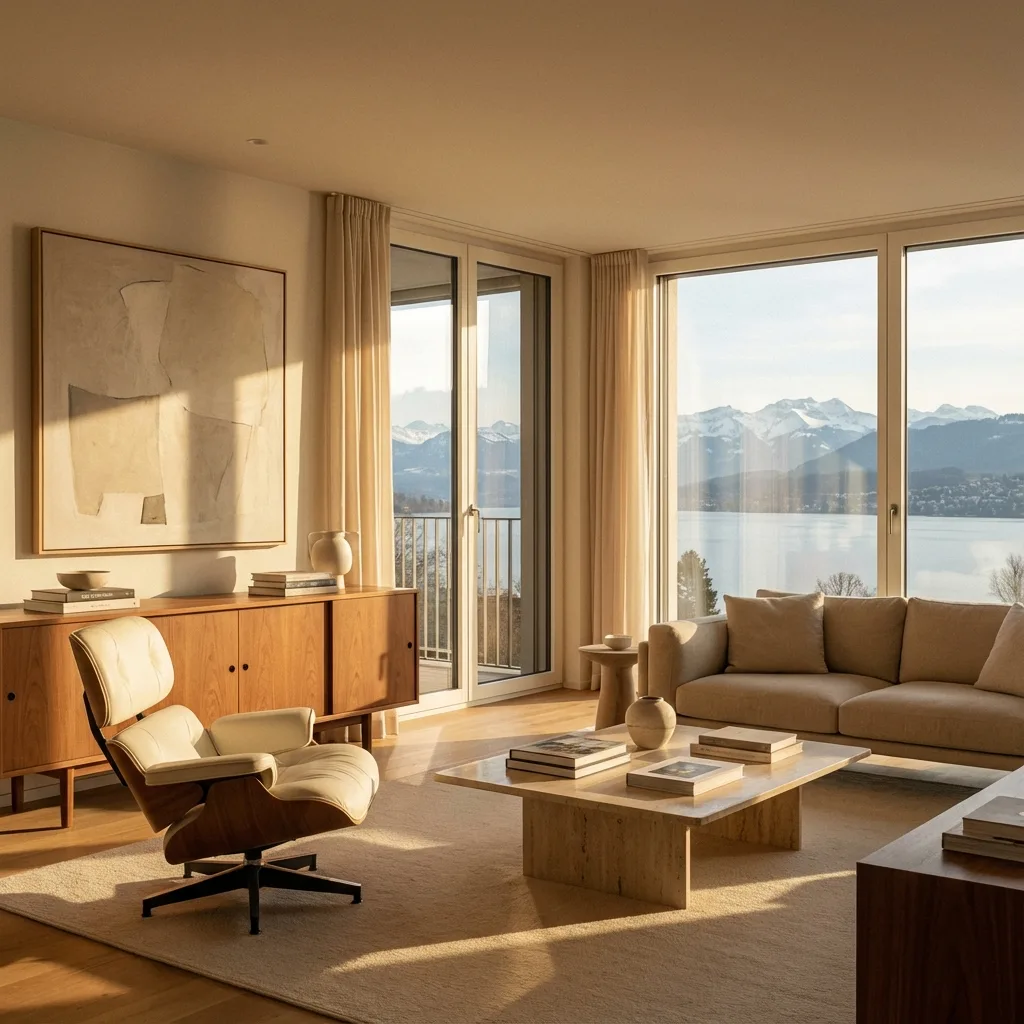
In apartment buildings, upper floors and attic apartments (Attika) trade at a premium, and lake or mountain views are explicitly modelled. In prime locations around Lake Zurich, Lake Geneva or Lake Lugano, the view can account for a substantial part of the value.
Building Age and Renovation State
A renovated turn-of-the-century building in Zurich's Kreis 7 carries heritage appeal. Unrenovated stock with original plumbing and single glazing is discounted heavily. A recent Minergie-P new build in Küsnacht or Zollikon achieves top prices per square metre thanks to low running costs and modern finishes.
Common Valuation Mistakes Owners Make
Working with property owners across Switzerland, we see the same errors repeatedly.
Emotional Pricing
You spent CHF 180,000 on a kitchen with Italian marble and top-of-the-range appliances. The market is likely to value that at a fraction of the cost. Over-capitalising (spending more on improvements than the market will return) is common in the upper segment. Bespoke taste is not universal value.
Ignoring Running Costs
Buyers are sophisticated. High heating costs signal poor insulation. High condominium fees or an underfunded renewal fund signal deferred maintenance. Smart buyers, and their bank's model, factor this in.
Anchoring to Purchase Price
You bought in Wollishofen in 2015. The market has risen, but has your segment risen the same way? Price growth in Switzerland has been uneven between regions, property types and conditions. Your purchase price is a historical fact, not a valuation.
Stop Searching.
Be Found.
Join the private network used by Switzerland's top executives. Start your onboarding with just your email.
Professional Valuation Options
When precision matters (for a sale, a refinancing, a divorce settlement or estate planning), you have several professional routes. The fees below are indicative ranges from our experience; ask for a quote.
| Option | Best for | Typical cost (indicative) |
|---|---|---|
| Online hedonic estimate | A first indication | Free |
| Bank appraisal (Bankschätzung) | Mortgage and refinancing | Often included in the mortgage process |
| Certified independent valuation (Verkehrswertschätzung) | Divorce, inheritance, tax, court, high-value sales | Around CHF 2,000–4,000, more for complex properties |
| Broker's comparative market analysis | Setting a sale price | Often free when you are considering a sale |
Bank Appraisals (Bankschätzung)
Every Swiss mortgage is based on a bank valuation, usually hedonic. It is typically conservative: banks value prudently to protect their loan-to-value ratios, so a bank appraisal is a floor rather than a sale price.
Certified Independent Valuation (Schätzung)
A certified valuer inspects the property, applies the appropriate methods (hedonic, income capitalisation or real value) and produces a detailed written report. This is the reference for legal proceedings, estate divisions and high-value sales. Professional bodies such as the Swiss valuers' associations (for example SIV and SEK/SVIT) and RICS list qualified members.
Comparative Market Analysis (CMA)
A CMA is what a skilled broker produces: an analysis of recent comparable transactions, competing offers and local demand. It is less formal than a certified valuation but more market-aware than a bank model. At Offlist, owners often ask for exactly this in the off-market segment: a realistic price range before deciding whether to list publicly or sell privately through our network.
When Market Value Diverges from Asking Price
Zurich: The Overbid Market
In Zurich's most sought-after districts (Seefeld, Enge, Zürichberg, Kilchberg), demand far exceeds supply, and well-presented properties can sell above the asking price. With the city's vacancy rate at around 0.1%, this dynamic makes accurate valuation more important: you need to know the realistic range before you set a price.
Geneva: A Two-Speed Market
In Geneva, international-grade properties in Cologny, Vandoeuvres or Champel are driven by diplomatic, institutional and private international demand, while other segments react more to economic cycles and interest rates. A property valuation in Geneva therefore needs local, segment-specific comparables, not just a canton-wide average.
Basel: Relative Value
Basel's price levels remain below Zurich's for comparable quality, while the life sciences cluster (Roche, Novartis) supports executive demand. Neighbourhoods such as Bruderholz and St. Alban attract buyers looking for quality at a lower entry price.
Conclusion
Your property is worth what the market says, not your memory, your renovation budget or your cantonal tax bill. In a market as data-driven and opaque as Switzerland's, guessing is expensive.
If you are considering a sale, a refinancing or simply want to understand your asset's position, invest in a professional valuation. If you own a rental, compare the value with the income it generates using our Swiss rental yield guide. For owners of premium properties weighing a public listing against a private sale, an accurate valuation is the foundation of every decision that follows. Our guide to selling property discreetly and our off-market vs on-market comparison cover the next steps, and how long it takes to sell a property in Switzerland shows why a realistic price is the biggest lever on timing.
Frequently Asked Questions (FAQ)
How do I get my property professionally valued in Switzerland?▼
Start with a free online hedonic estimate, then choose the professional that fits the purpose: a certified valuer for legal, tax or family matters, your bank for refinancing, or an experienced local broker for a sale. Provide the land registry extract, floor plans, renovation history and energy certificate so the valuation is based on facts.
How often should I get my property revalued?▼
Every few years, and whenever you are considering refinancing, selling or a major renovation. Market conditions in Swiss cities can shift meaningfully within two to three years. Free online hedonic tools (such as those from Wüest Partner or RealAdvisor) are useful for an annual directional check.
Can I use the cantonal Steuerwert as a basis for pricing my property?▼
No. The Steuerwert is a fiscal figure, usually set well below market value and only revised periodically. Using it as a pricing basis will leave money on the table. Always use a hedonic model, a professional valuation or current transaction knowledge for market decisions.
Does Minergie certification really add value, or is it just marketing?▼
It adds measurable value. A Zürcher Kantonalbank study found premiums of around 7% for single-family houses and around 3.5% for multi-family buildings compared with conventional construction. Beyond the label, lower energy costs matter increasingly to buyers and tenants who look at the total cost of occupancy.
What is the difference between a Verkehrswert and a Marktwert?▼
In practice, they are used interchangeably: both describe the price a property would likely achieve in an arm's-length sale on the open market. "Verkehrswert" is more common in legal, tax and banking contexts, while "Marktwert" is the everyday and broker term. A certified valuation will normally state the Verkehrswert as its conclusion.

About the Author
Benjamin Amos Wagner
Founder of Expat-Savvy.ch & Offlist | Connecting Expats with Homes
Selling or renting out discreetly?
Offlist matches your property with vetted buyers and tenants – no public listing, no upfront fees.
See how it works for owners