Luxury Rentals in Lugano & Ticino: An Expat Guide (2026)
Key Takeaways
- Mediterranean lifestyle, Swiss stability: Ticino is among the sunniest parts of Switzerland, with Italian language and culture and the full infrastructure of one of the world's most stable countries: banking, healthcare, rule of law.
- Luxury rental range: In our experience, premium apartments in Lugano's best neighborhoods (Castagnola, Paradiso, Collina d'Oro) rent for roughly CHF 5,000–15,000 per month. Lakefront villas with pools and gardens can exceed CHF 20,000.
- The forfait tax connection: Many of Ticino's luxury tenants are high-net-worth individuals on lump-sum taxation — a unique Swiss regime that attracts global wealth to the region.
- Off-market is essential: In a market this small, the best properties circulate through personal networks long before they reach any portal. Connections matter more here than anywhere else in Switzerland.
For a luxury rental in Ticino, focus on Castagnola and Paradiso for lake views close to Lugano, Collina d'Oro for hillside villas and schools, and Ascona or Morcote for smaller, quieter settings. The market is small, so many of the best homes are let privately. Plan for a weeks-long search, not days.
If you have spent time in Zürich or Geneva, arriving in Lugano feels like stepping into a different country. The palm trees, the espresso culture, the lakefront piazzas where lunch stretches past three — it is unmistakably Italian. Yet the trains run on time, the banks are discreet, and the political stability is absolute. Ticino is Switzerland's paradox: Mediterranean warmth delivered with Swiss precision.
For expats seeking luxury living in Switzerland, Ticino is a genuinely different proposition. Day-to-day costs are generally lower than in Zürich and Geneva, particularly away from the prime lakefront. The canton also has a long tradition of welcoming high-net-worth individuals under lump-sum taxation. And the quality of life, measured in sunshine, lake access, mountain proximity, and culinary excellence, is arguably unmatched.
The catch? Ticino's luxury rental market is tiny. There is no equivalent of Zürich's Seefeld with hundreds of premium units turning over each year. The best properties — lakefront villas in Castagnola, hilltop estates on Collina d'Oro — are held by families for generations and rented quietly through personal networks. If you are searching on Homegate, you are seeing the leftovers.
Why Ticino Draws Global Wealth
The Climate Advantage
South of the Alps, Ticino gets noticeably more sunshine than Zürich or Basel, and Lugano and Locarno are among the sunniest towns in the country. Winters are mild by Swiss standards, with Lugano rarely seeing sustained sub-zero temperatures at lake level. The botanical gardens bloom year-round. For anyone relocating from a Mediterranean country or simply tired of grey Swiss winters, Ticino is the obvious choice.
The Lump-Sum Tax Regime
Switzerland's Pauschalbesteuerung (lump-sum taxation, or forfait fiscal) allows qualifying foreign nationals who do not work in Switzerland to be taxed on their living expenses rather than their worldwide income. Ticino is one of the most popular cantons for this arrangement, alongside Vaud, Valais and Geneva. Cantonal minimum tax bases differ, and Ticino's has historically sat at the lower end of the range; confirm current figures with the cantonal tax office. Our guide to lump-sum taxation and housing explains how your rent feeds into the tax base.
This creates a concentration of ultra-high-net-worth residents who live in Ticino precisely because of the tax framework. They are your neighbors in Collina d'Oro and Castagnola, and they are the reason the luxury rental market sustains price levels that the local economy alone could not support.
Milan Proximity
Lugano is roughly an hour by road from Milan Malpensa airport and a little over an hour from Milano Centrale by direct train. For executives whose professional life spans Milan, London and the Middle East, Ticino offers genuinely convenient connections. Since the Ceneri Base Tunnel opened in 2020, Zürich HB is about two hours away by train.
Lugano Neighborhoods: Where to Live
Castagnola
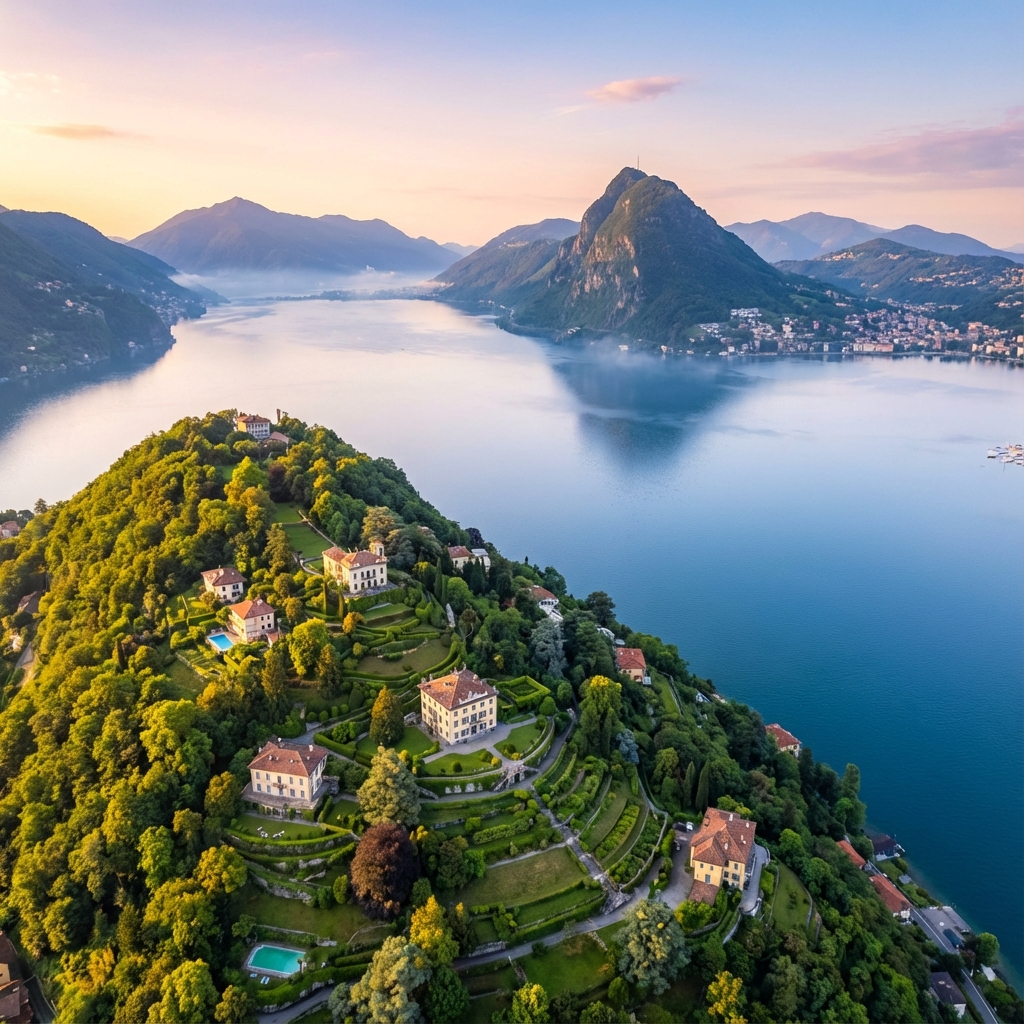
The undisputed premium address. Castagnola sits on the eastern shore of Lake Lugano, directly below Monte Bré, and offers the kind of properties that simply do not exist in most Swiss cities: lakefront villas with private boat moorings, infinity pools overlooking the water, and gardens shaded by century-old cypress trees. Rents for top-tier properties range from CHF 8,000 to CHF 15,000 per month, with exceptional estates occasionally exceeding CHF 20,000.
The drawback: availability. Castagnola's housing stock is limited, turnover is low and, in our experience, most lettings happen off-market. When a villa does become available, qualified tenants who are already known to the owner or their agent have the advantage. Our guide to ultra-luxury rentals in Switzerland explains how that top tier works.
Paradiso
South-facing, elegant, and more urban than Castagnola. Paradiso offers apartment living at a high standard — modern buildings with lake-facing balconies, underground parking, and proximity to Lugano's best restaurants and shopping. This is where you find luxury apartments (as opposed to villas) at CHF 5,000 to CHF 10,000 per month. The funicular to Monte San Salvatore departs from Paradiso, adding a scenic dimension to daily life.
Montagnola and Collina d'Oro
The hillside communes above Lugano — Montagnola, Gentilino, and Agra collectively form the Collina d'Oro (Hill of Gold), named not for its views (though they are spectacular) but for the wealth concentrated here. Collina d'Oro's municipal tax rate is among the lowest in Ticino, making it the preferred address for lump-sum taxpayers.
Hermann Hesse lived in Montagnola for over 40 years, and the village retains a tranquil, artistic character. Properties here offer panoramic views across the lake to the Alps, private gardens, and the quiet that executives escaping the noise of global business seek. Expect CHF 4,500 to CHF 8,000 for a premium apartment, CHF 6,000 to CHF 12,000 for a villa.
Lugano Centro and the Old Town
For those who want urban convenience — restaurants within walking distance, the LAC (Lugano Arte e Cultura) cultural center, the lakefront promenade, and direct train station access — central Lugano delivers. The housing stock here is predominantly apartments, including some beautifully renovated historic buildings in the Old Town. Rents for quality apartments range from CHF 3,500 to CHF 6,000 per month. Not the most exclusive address, but the most livable for day-to-day convenience.
Beyond Lugano
Ascona
Ascona's lakefront piazza — with its pastel-colored buildings, outdoor cafés, and sailing boats bobbing in the harbor — is one of the most photographed scenes in Switzerland. The town has a long artistic heritage, shaped by the Monte Verità colony of artists and reformers in the early 20th century, and attracts a cosmopolitan crowd. Premium apartments and villas command CHF 5,000 to CHF 10,000 per month, with exceptional properties above that.
Locarno
Home to the renowned Locarno Film Festival, this city on Lake Maggiore offers a more accessible price point than Ascona while maintaining genuine character. For families or executives who do not need to be in Lugano daily, Locarno provides excellent value: quality apartments from CHF 2,500 to CHF 4,500.
Morcote
A hillside village clinging to the southern shore of Lake Lugano, Morcote is ultra-exclusive and ultra-small. Properties here are rare, expensive, and almost never publicly listed. If you want the ultimate private retreat in Ticino, this is it — but expect to pay accordingly and to wait for availability.
The Rental Market: What to Expect
A Small, Tight Market
Ticino's luxury rental market is fundamentally different from Zürich or Geneva. The entire canton has roughly 350,000 inhabitants, fewer than the city of Zürich alone. In our experience, the luxury segment (properties above CHF 5,000 per month) counts available units in the dozens at any given time, not the hundreds.
This scarcity cuts both ways. For tenants, it means fewer options and the need to act quickly when something appears. For landlords, it means strong pricing power and minimal vacancy on quality properties. For both parties, it means that off-market access is not a luxury — it is a necessity.
Furnished Is the Norm at the Top
Unlike German-speaking Switzerland, where unfurnished rentals dominate, Ticino's luxury market skews heavily toward furnished properties. Many owners maintain their homes to a high standard and rent them furnished during periods of absence. Furnished properties command a clear premium over unfurnished equivalents, reflecting the quality of the furnishing and the convenience for international tenants. Our guide to furnished vs unfurnished renting helps you weigh the trade-off.
Off-Market Dominates
In Lugano and the surrounding communes, the most desirable properties rarely appear on Homegate or ImmoScout24. They circulate through personal networks — wealth managers, family offices, trusted advisors — or through curated platforms like Offlist that maintain direct relationships with private owners. If you are searching only on public portals, you are seeing only part of what is actually available at the premium end.
Stop Searching.
Be Found.
Join the private network used by Switzerland's top executives. Start your onboarding with just your email.
Practical Considerations
International Schools
Ticino offers strong international schooling options:
- TASIS (The American School in Switzerland): Located in Montagnola on the Collina d'Oro. Day and boarding, with American and IB programmes, on a hillside campus with views across the lake. Check current fees directly with the school.
- Bilingual private schools: Several private schools in and around Lugano offer English-Italian programmes, particularly for younger children.
For families committed to Italian-medium education, the cantonal public schools in Ticino are excellent and free — a genuinely viable option for younger children who will acquire Italian quickly.
Healthcare
Ticino's healthcare infrastructure includes the Clinica Luganese Moncucco, Cardiocentro Ticino, and the Ospedale Regionale di Lugano — all offering Swiss-standard medical care. For expats accustomed to private healthcare, the region's private clinics provide comprehensive services. Milan's world-class hospitals are also within easy reach for specialized treatment.
Getting Around
Lugano is compact and navigable. The city center is walkable, a funicular connects the lakefront to the train station, and the surrounding communes are well served by bus routes. A car is useful for reaching hillside properties and exploring the wider region, but not essential for daily life. The A2 motorway connects Lugano to Bellinzona (north), Chiasso (south, Italian border), and ultimately to Zürich (2.5 hours) and Milan (1.5 hours).
Conclusion
Ticino occupies a unique position in the Swiss luxury landscape. It offers something that no other part of the country can match: genuinely Mediterranean living within the Swiss framework. The trade-off is a smaller market, fewer employment options, and a distance from the Zürich–Geneva economic axis that makes it less practical for executives who need to be in those cities daily.
For retirees, remote workers, HNWI individuals on lump-sum taxation, and executives whose business takes them to Milan more than Paradeplatz, Ticino is not a compromise. It is the optimal choice. If you are thinking of buying rather than renting, check what Lex Koller allows foreign buyers first; Ticino is one of the cantons with holiday-home quotas. The key is access. In a market this small and this relationship-driven, finding the right property means having the right connections. That is precisely what Offlist provides: curated access to Ticino's premium rental inventory, matched to your requirements before a property reaches a public listing. Create a free private profile to get started.
Frequently Asked Questions
How much does a luxury apartment cost to rent in Lugano?
Premium apartments in desirable neighborhoods — Castagnola, Paradiso, Collina d'Oro — range from CHF 5,000 to CHF 15,000 per month depending on size, views, and furnishing. Lakefront villas with private gardens and pools can exceed CHF 20,000. Standard quality apartments in central Lugano start around CHF 2,500–3,500.
Is Lugano good for expat families?
Yes. International schooling is well established (TASIS in Montagnola, plus bilingual private schools), the city is safe and walkable, the lake offers year-round recreation, and the Italian-speaking environment gives children a valuable third language. The main consideration is career: Lugano's job market is smaller than Zürich or Geneva, so most expat families are either remote workers, on lump-sum taxation, or commuting to Milan.
Can I commute from Lugano to Zürich or Milan?
Milan is practical: Malpensa airport is about one hour by car, and Milano Centrale is a little over an hour by direct train. Zürich is less practical for daily commuting at about two hours each way by train, though some executives manage a Monday-to-Thursday arrangement with a Ticino base on weekends. Many Ticino-based executives work remotely with periodic travel — the lifestyle justifies the logistical trade-off.

About the Author
Benjamin Amos Wagner
Founder of Expat-Savvy.ch & Offlist | Connecting Expats with Homes