How to Buy a Penthouse Off-Market in Zurich: Complete 2026 Buyer's Guide
To buy a penthouse off-market in Zurich, you need three things before the first viewing: a written financing confirmation (or proof of funds), a clear Lex Koller position if you are not Swiss, and a precise brief that networks and brokers can match against. Good top-floor apartments are usually offered to a short list of known buyers before anyone considers a public listing. Once you agree terms, the purchase is notarised by the local Zurich Notariat and completed with the land register entry, typically four to eight weeks later.
Why Zurich Penthouses Rarely Reach the Portals
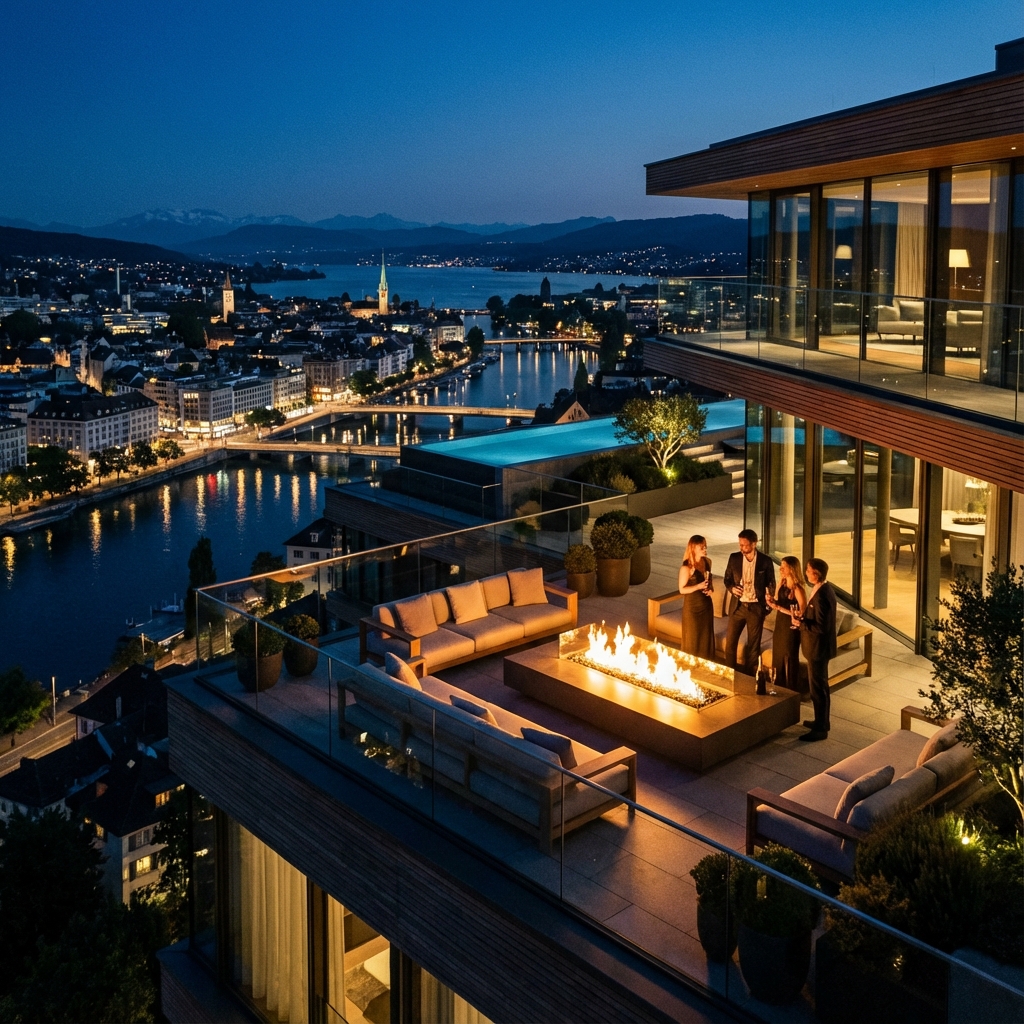
In Zurich, a penthouse is usually an Attika: a top floor set back from the facade, which creates a wraparound terrace. Most residential buildings are only a few storeys high, so each building has at most one, and owners tend to keep them for years. When one does come up, the owner often wants discretion (no photos of the interior online, no queue of curious viewers) and a buyer who can close.
That is why most transactions at this level run through private banks, specialised brokers and curated networks rather than Homegate or ImmoScout24. For the wider market, including district price levels and the seller's side, read our pillar guide to off-market property in Zurich. For the trade-offs between both routes, see off-market vs. on-market property.
Where to look
- Seefeld and the lower Zürichberg for lake views, historic buildings with modern top floors and walkable city life
- Enge and Wollishofen for lake proximity, newer residential buildings and quick access to Paradeplatz
- Fluntern, Hottingen and Hirslanden for larger floor plans, quiet streets and green views
- The Gold Coast (Küsnacht, Zollikon, Erlenbach) if you are open to leaving the city limits for lower municipal tax rates and lakefront buildings
Our Seefeld and Enge neighbourhood guide describes the two most sought-after districts in detail.
Stop Searching.
Be Found.
Join the private network used by Switzerland's top executives. Start your onboarding with just your email.
Financing a CHF 3M+ Penthouse: What Swiss Banks Require
Swiss mortgage underwriting is standardised by the banks' self-regulation, which FINMA recognises as a minimum standard. For luxury properties, most lenders go further.
Equity and loan-to-value
The baseline rules for an owner-occupied home (Swiss Bankers Association):
- At least 20% equity, of which at least 10% of the lending value must be "hard" equity, not money from your occupational pension fund
- Amortisation of the mortgage down to two-thirds of the lending value within 15 years
For high-value properties, many banks cap the loan-to-value below 80%, and the lending value they accept for a penthouse can be lower than the price you agree. In practice, budget for 30–40% equity at this level (indicative; it depends on the bank and your profile).
Affordability: the one-third rule
Banks also test whether you could carry the mortgage if rates rose. The usual method uses an imputed interest rate of around 5%, plus amortisation and maintenance costs of around 1% of the property value per year. The total should not exceed about one-third of your gross income. Exact parameters vary by bank.
Worked example (CHF 5 million penthouse, CHF 3.5 million mortgage, 70% loan-to-value):
- Imputed interest at 5%: CHF 175,000
- Amortisation to two-thirds within 15 years: about CHF 11,000
- Maintenance at 1% of the property value: CHF 50,000
- Total imputed housing cost: about CHF 236,000 a year
To pass the one-third test, you would need a gross annual income of roughly CHF 710,000. With more equity, the required income falls quickly: at a CHF 2.5 million mortgage, it drops to around CHF 530,000.
Wealthy buyers with modest taxable income can sometimes qualify by pledging additional assets or through private-banking lending based on their overall wealth. Discuss this early, because it takes longer to set up.
Which banks finance luxury homes?
- UBS, which now includes the former Credit Suisse, especially for existing private-banking clients
- Zürcher Kantonalbank (ZKB), often competitive for properties in the canton
- Other cantonal and regional banks, insurers and pension funds, which can be price-competitive for mortgages within standard limits
- Private banks such as Pictet, Lombard Odier or Julius Bär, which lend mainly to clients with significant assets under management
If you already bank with a private bank or wealth manager, start there. Existing clients usually get faster decisions.
Lex Koller: Can You Buy as a Foreigner?
The Federal Act on the Acquisition of Real Estate by Persons Abroad (Lex Koller) decides whether you need an authorisation:
- Swiss citizens, EU/EFTA nationals living in Switzerland, and C permit holders can buy without authorisation.
- Non-EU nationals with a B permit can currently buy a main residence for their own use at their place of residence. A proposed revision, in public consultation until July 2026, would require authorisation for them in future (Grundeigentümer Verband Schweiz).
- Buyers living abroad cannot generally buy a residential property in Zurich. Holiday-home quotas only exist in designated tourist areas, and Zurich is not one of them.
Clarify your status before you make an offer; a seller will ask. Our complete Lex Koller guide covers the details.
The Legal Steps: Notary, Contract and Land Register
Swiss property law is federal, but procedures are cantonal. In the canton of Zurich, purchase contracts are notarised by the official district Notariate, which also run the land registers.
Step 1: Reservation or pre-contract
Once you agree on price and handover date, the parties often sign a reservation agreement while the notary prepares the contract. Be careful with deposits at this stage: under Swiss law, a pre-contract for real estate is only binding if it is notarised, and the Federal Supreme Court has held that informal reservation agreements with a financial penalty are not enforceable. If you need real exclusivity, ask the notary about a notarised pre-contract or purchase right.
Step 2: Due diligence
Before signing, check:
- The land register extract: ownership, mortgages, easements and any rights of way or building restrictions
- For condominiums (Stockwerkeigentum): the regulations, recent meeting minutes, the renewal fund balance and any planned works or special levies
- Use rights for the roof terrace: whether it is part of your unit or a common area with exclusive use
- Energy standard, heating system and any recent renovations
For CHF 3M+ purchases, many buyers ask a real estate lawyer to review the draft contract.
Step 3: Signing at the Notariat
The notary drafts the purchase contract (Kaufvertrag), reads it to both parties and witnesses the signatures. The purchase price is secured before or at signing, typically through an irrevocable payment promise from the buyer's bank.
Step 4: Land register entry and handover
Ownership passes when the transfer is entered in the land register. The seller hands over the keys on the agreed date, usually aligned with payment.
What it costs
- No property transfer tax. The canton of Zurich abolished its Handänderungssteuer on 1 January 2005 (Kanton Zürich).
- Notary and land register fees: roughly 1‰ of the price each, plus VAT on the notarial part. Creating or increasing mortgage notes (Schuldbriefe) costs extra. The Notariate publish an online fee calculator.
- Advisers: legal review, and a broker's fee if you mandated a buyer's agent.
Costs of Owning a Penthouse in Zurich
Condominium charges
Most Zurich penthouses sit in condominium buildings. The owners' association charges monthly contributions for building insurance, lift maintenance, heating (if central), cleaning, administration and the renewal fund. In a luxury building, expect indicatively CHF 800 to 1,500 a month for a large top-floor unit.
Renewal fund and special levies
Façades, roofs and lifts need periodic renewal. The association builds a renewal fund, but penthouses with large terraces and custom installations can face additional costs. Many owners set aside around 0.5–1% of the property value per year for maintenance (indicative).
Taxes
- No annual property tax in Zurich. Unlike some cantons, Zurich does not levy a Liegenschaftssteuer.
- Imputed rental value (Eigenmietwert): Owner-occupiers are still taxed on a notional rental income. Swiss voters approved its abolition in September 2025; the Federal Council plans the change for 1 January 2029 (Federal Department of Finance).
- Wealth tax: The property's tax value, minus the mortgage, counts towards your taxable net wealth each year.
- Property gains tax on sale: When you sell, Zurich taxes the gain, with lower rates the longer you have owned the property.
Why Off-Market Penthouse Purchases Tend to Move Faster
There is no official data on off-market transactions, but three structural reasons explain why they usually close faster than public listings:
1. A pre-qualified buyer pool
A prime penthouse on a portal attracts many enquiries, most of them from people without financing, without purchase intent or without the right to buy under Lex Koller. Off-market networks screen buyers first: financing confirmed, identity verified, Lex Koller position clear, timeline committed. The seller only meets serious buyers.
2. Bilateral negotiation
Public listings in high-demand districts can turn into competitive bidding. Off-market deals are negotiated one to one, with both parties informed, which keeps the process calmer and more predictable.
3. Discretion has value for sellers
For many penthouse owners, privacy matters as much as the last franc: no public listing, no open viewings, no months of negotiation. Buyers who respect that, keep information confidential and can close quickly are the ones who get introduced first.
When you are ready, create your free private profile with your brief and financing range, so owners and brokers can match you with top-floor apartments before they are advertised.
Frequently Asked Questions
Can I buy a Zurich penthouse as a non-Swiss, non-EU national?
Yes, if you live in Switzerland with a B or C permit and the penthouse will be your main residence. C permit holders buy without restrictions; B permit holders from outside the EU/EFTA can currently buy a main residence for their own use, although a proposed Lex Koller revision would change that. If you live abroad, you generally cannot buy a residential property in Zurich. Read our complete Lex Koller guide.
What is the typical down payment for a CHF 5 million penthouse?
The regulatory minimum is 20% equity, with at least 10% as hard equity. For luxury properties, banks often lend less, so budget for 30–40% equity (CHF 1.5–2 million on a CHF 5 million penthouse) as an indicative planning figure, and confirm with your bank early.
How long does it take to close an off-market penthouse purchase in Zurich?
Typically four to eight weeks from agreed terms to key handover, if financing is already confirmed: about one to two weeks for due diligence and the notary's draft, a signing appointment at the Notariat, then payment and the land register entry.
Do I need a real estate lawyer for a Zurich penthouse purchase?
It is not legally required, because the notary handles the formal steps. For CHF 3M+ purchases, and especially for non-Swiss buyers, a Swiss real estate lawyer is recommended to review the contract, the condominium regulations and the land register extract before you sign.
Is there a transfer tax when buying property in Zurich?
No. The canton of Zurich abolished its property transfer tax in 2005. You pay notary and land register fees of roughly 1‰ of the price each, plus fees for any mortgage notes.