Rent in Switzerland Without a Permit: Expat Guide (Legal)
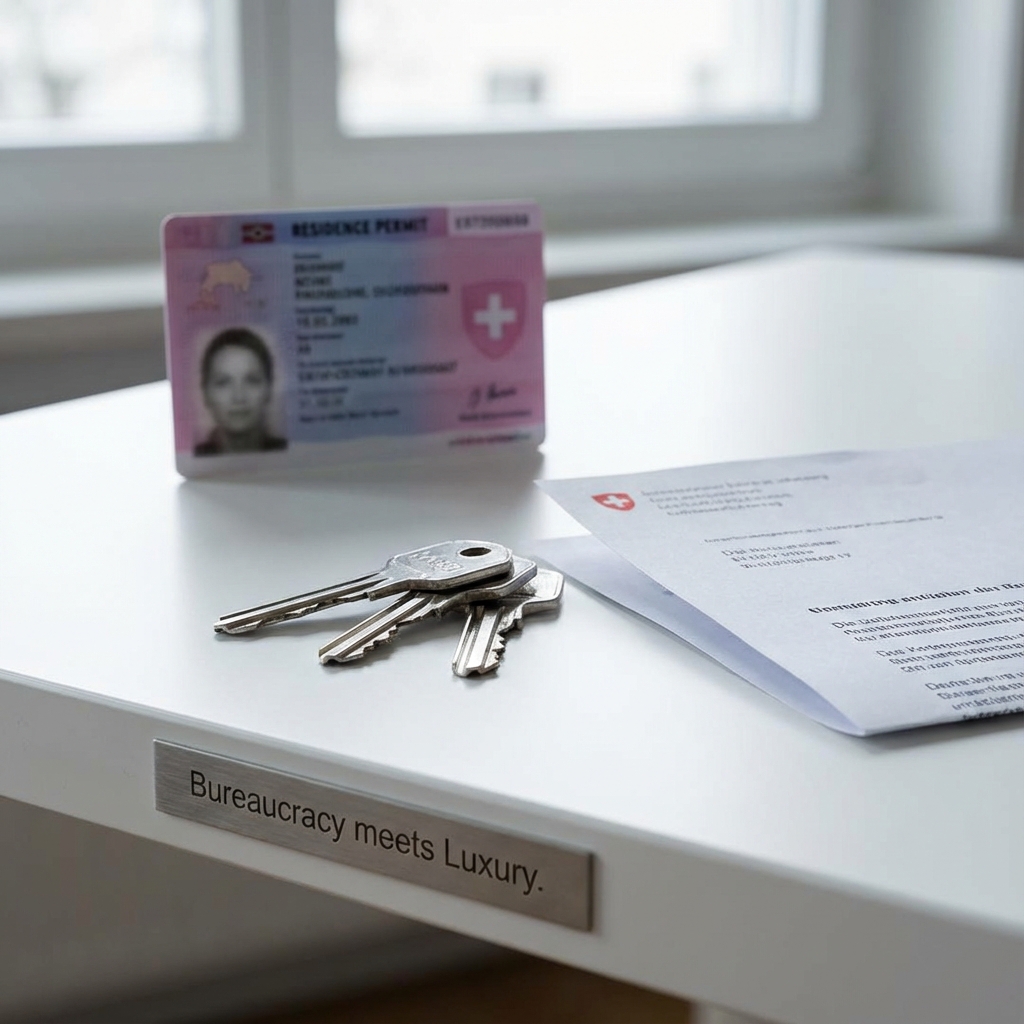
TL;DR / Executive Summary
- The Bureaucratic Catch-22: To register and receive your permit card, you need a Swiss address, usually proven with a lease. Many large property agencies (Verwaltungen), in turn, ask for a permit card before they let you sign a lease.
- The Crucial Document: You do not legally need the physical permit card to sign a lease. What convinces landlords is the canton's assurance of a residence permit (Zusicherung der Aufenthaltsbewilligung) or, for EU/EFTA citizens, a signed Swiss employment contract.
- The Algorithmic Rejection: Despite the law, public real estate portals and their automated application software often instantly reject dossiers that leave the "Permit Upload" field blank.
- The Off-Market Solution: Private off-market landlords understand international relocation timelines. They accept the assurance letter and can agree to a "permit denial clause" that removes your risk.
Yes, you can rent an apartment in Switzerland before your permit card exists. You sign the lease with your passport, your employment contract and, if you are a non-EU national, the canton's written assurance that your permit has been approved. You then register at your new address within the deadline, and the permit card follows.
If you are relocating to Switzerland—particularly from outside the European Union (e.g., the United States, the United Kingdom, or Singapore)—you will inevitably collide with what immigration lawyers call the "Permit Wall."
The scenario is remarkably consistent across all cantons:
- You find a beautiful apartment online. You apply.
- The digital application form demands a scanned copy of your Swiss Residence Permit (Ausländerausweis).
- You do not have the physical card yet because you haven't arrived in the country. You either leave the field blank or upload your passport.
- You are instantly rejected by the property management firm.
Frustrated, you pivot your strategy. You contact the Cantonal Migration Office to finalize your permit so you can finally rent an apartment.
- The Migration Office asks to see your permanent residential Swiss address.
- You explain that you cannot secure an address without the permit.
- They politely decline to issue the permit until you return with a signed lease.
This circular bureaucratic nightmare represents the single highest source of stress for incoming executives and their families. However, the system is not actually broken; it simply operates on a rigid sequence that public housing agencies refuse to accommodate.
Here is exactly how you break the cycle and secure your lease before you even land in Zurich or Geneva.
The Immigration Reality: EU vs. Non-EU
The flexibility of a landlord often depends entirely on the color of your passport. Switzerland operates on a dual-track system for immigration.
Track 1: For EU/EFTA Citizens
If you hold an EU/EFTA passport, the process is inherently simpler. Under the Agreement on the Free Movement of Persons, you possess an inherent right to reside in Switzerland provided you have a valid employment contract.
- The Required Document: Your signed Swiss employment contract is usually sufficient proof of solvency and legal status for a landlord. It entitles you to a permit on registration: a B permit for contracts of a year or more, an L permit for shorter ones.
- The Landlord View: Most private landlords and even public agencies accept an EU passport combined with an Employment Contract without significant administrative pushback.
Track 2: For Non-EU Citizens (Third Country Nationals)
If you hold a US, UK, Indian, or Chinese passport, your right to live and work in Switzerland is absolutely not automatic. You are subject to strict national quotas.
- The Required Document: You require a formal letter called the "Zusicherung der Aufenthaltsbewilligung" (Assurance of Residence Permit). The cantonal migration office issues it before you arrive, once your employer's application has been approved and a quota place allocated. If you need a visa, the canton also sends an authorisation to the Swiss embassy to issue your entry visa (Ermächtigung zur Visumerteilung).
- The Landlord View: This is where the friction occurs. A standard, massive public property management firm (Verwaltung) views Non-EU applicants as "High Flight Risk." Even if you present the Assurance Letter, junior clerks at the agency often do not understand the document. They fear that if your actual visa is somehow denied at the border, they will be left with an empty apartment and lost rental income. Consequently, they pass over your dossier in favor of a local Swiss applicant who poses zero administrative risk.
Stop Searching.
Be Found.
Join the private network used by Switzerland's top executives. Start your onboarding with just your email.
How to Secure an Apartment Without the Physical Card
You cannot change Swiss immigration law, but you absolutely can control how you present your evidence to a prospective landlord. If you must apply on the public market, you need a flawless defensive strategy.
1. Weaponize the "Assurance Letter"
Do not merely write a polite email stating, "I have applied for my permit and HR says it is fine." Words hold zero weight in Swiss real estate. You must attach the official PDF of the Assurance Letter from the Canton. In your cover letter, explicitly state: "Attached is the official cantonal 'Zusicherung', which is the legally binding confirmation of my B-Permit approval prior to the issuance of the physical card."
2. The Corporation "Letter of Comfort"
If you are relocating under the sponsorship of a major multinational firm (e.g., Google, Roche, Novartis, UBS), leverage their institutional weight. Ask your Global Mobility or HR department for a formal "Letter of Comfort" (Garantieschreiben).
- What it says: "Mr. Smith is a Senior Vice President. His work permit is actively sponsored by our legal department and its final issuance is a mere administrative formality."
- Why it works: This is a psychological masterstroke. It shifts the landlord's risk perception from you (an unknown foreign individual) to the corporation (a massive, blue-chip Swiss entity). A property manager is far less likely to reject Google than they are to reject John Smith.
The Pivot: Why Off-Market Landlords Win
While the strategies above can occasionally pierce the armor of public agencies, relying on them is exhausting. Institutional landlords rely on software (like Flatfox or Tayo) to screen thousands of applicants. If their software's "Permit Upload" field expects a specific file type and you upload a letter instead, the algorithm will auto-reject you instantaneously.
Private Landlords and Off-Market Networks operate on human logic, not algorithmic rigidity.
- Understanding of Mobility: Private landlords dealing in premium off-market properties actively court international executives. They fully understand that a Senior VP transferring from London to Zurich simply does not have a Swiss ID card yet. They recognize the "Assurance Letter" immediately.
- The "Permit Denial Clause": Because private landlords are flexible, many will agree to a conditional clause in the lease stating that the contract lapses if the Swiss authorities refuse the permit. This removes most of the financial risk for the incoming executive. Good luck asking a massive public agency to rewrite their standard 15-page legal lease to accommodate your specific visa situation.
The Offlist Advantage This is exactly why high-net-worth individuals and executives abandon the public market. Platforms like Offlist curate private landlords who specifically want corporate, expat tenants. By applying through an off-market channel, you are engaging with decision-makers who view your international status as an asset, not an administrative burden. You bypass the algorithmic rejection entirely.
The Precise Registration Sequence
Once you bypass the bureaucracy and a private landlord countersigns your lease using your Assurance Letter, the sequence of your arrival is legally critical. Do not deviate from these steps:
- Sign the Lease from Abroad: Secure the countersigned Swiss rental contract digitally.
- Cross the Border: Enter Switzerland using your entry visa (if applicable) or your passport.
- The Kreisbüro / Contrôle des habitants: Within 14 days of arrival, and before you start work, you must register with your municipality. Some cities set a shorter deadline (Lausanne and Lugano ask for 8 days in most cases), so check the local rule.
- Present the Trifecta: Hand the clerk three documents: Your Passport, your countersigned Lease Agreement, and your Assurance Letter.
- Finalization: Because you now have a registered address (proven by the lease), the municipality triggers the final printing of your permit.
- Receive the Card: Non-EU nationals give their biometric data at a cantonal appointment; the permit card then arrives by post, typically a few weeks later.
City by City: Renting Without a Permit
The rules above are federal, but each city has its own registration office, deadlines and market conditions.
How to rent an apartment in Zurich without a permit
Zurich is the tightest market of the five: on 1 June 2025 the city had just 235 vacant apartments, about 0.1% of its stock (Stadt Zürich). Large managers screen digitally, so a missing permit upload can end your application. Apply with the cantonal assurance letter or, as an EU/EFTA citizen, your signed contract, plus a home-country credit report in place of the Swiss debt extract. Register at your Kreisbüro within 14 days. Use our Zurich rental document checklist so nothing is missing.
How to rent an apartment in Geneva without a permit
Geneva's canton had the second-lowest vacancy rate in Switzerland on 1 June 2026, at 0.31% (FSO via WBF). Most rentals are handled by régies, and applications, leases and correspondence are in French. You announce your arrival to the cantonal population office (OCPM) within 14 days. Staff of international organisations usually receive a legitimation card from the Federal Department of Foreign Affairs instead of a permit; landlords in Geneva know this document well. More in our guide to private landlord rentals in Geneva.
How to rent an apartment in Lausanne without a permit
The canton of Vaud reported a provisional vacancy rate of 0.87% on 1 June 2026 (State of Vaud). Régies expect a French-language dossier with the extract from the debt collection register (extrait du registre des poursuites). Lausanne's Contrôle des habitants asks new residents to register in person, in most cases within 8 days of arrival. EPFL, IMD and multinational employers often provide confirmation letters that régies accept. See our Lausanne expat housing guide.
How to rent an apartment in Lugano without a permit
Ticino is the least tight of these markets, with a cantonal vacancy rate of 1.78% on 1 June 2026 (FSO via WBF), so landlords are more open to negotiation. Leases and correspondence are in Italian. The City of Lugano asks new residents to register at a Puntocittà counter within 8 days of arrival, and building managers must report new tenants to the city's resident control office (Città di Lugano). Our Lugano and Ticino luxury rentals guide covers neighbourhoods and prices.
How to rent an apartment in Basel without a permit
Basel-Stadt's vacancy rate fell to 0.8% on 1 June 2026 (Statistisches Amt Basel-Stadt). Roche, Novartis and their suppliers bring in a steady flow of international hires, so many landlords are used to permit assurances and corporate confirmation letters. Our Basel corporate housing guide explains which districts suit which campus.
Conclusion
You absolutely do not need a physical permit card to rent an apartment in Switzerland; you merely need bulletproof proof of legal eligibility.
The public rental market is often far too rigid and over-subscribed to understand or accommodate this critical distinction. To efficiently secure premium housing before you even pack your bags, you need to abandon the public portals. You must deal directly with human decision-makers in the private, off-market ecosystem who speak English, understand executive relocation, and value your tenancy. Create your free private profile and attach your assurance letter once; landlords who accept it can then contact you directly.
Frequently Asked Questions (FAQ)
Can I rent an apartment in Switzerland without an employment contract?▼
Yes, but you need another way to prove you can pay: a bank reference letter confirming sufficient assets, recent tax returns, or a guarantor. Without a Swiss job, you also need a residence permit on another basis, for example as a financially independent person.
Can I just use a hotel address to register for my B-Permit?▼
Generally, no. Cantonal migration offices require a permanent, verifiable residential address. However, they do legally accept long-term Serviced Apartments (like VisionApartments or CityPop) provided that the operator issues a formal "Wohnungsnachweis" (Proof of Accommodation) document. Standard tourist hotels will not issue this document.
Does the "type" of permit I am getting affect my ability to convince a landlord?▼
Yes, dramatically. A "B Permit" (Resident) is highly preferred and is treated almost identically to a permanent C-Permit by landlords. An "L Permit" (Short-term, valid for <1 year) makes it exceptionally difficult to sign an unfurnished, long-term lease. Landlords fear the high turnover cost of you leaving in 12 months. For L-Permit holders, furnished off-market rentals are almost always the only viable solution.
What happens if I sign a lease, but my permit is surprisingly denied at the last minute?▼
If you signed a standard lease without a "permit denial clause," you remain liable for the rent. You will have to pay until you find a suitable replacement tenant ("Nachmieter") or until the next contractual termination date, which could be several months away. This is why negotiating with a private landlord for a protective clause is essential.

About the Author
Benjamin Amos Wagner
Founder of Expat-Savvy.ch & Offlist | Connecting Expats with Homes


